

 Apple Podcasts
 Spotify
 Youtube Music
 A LEGO World Revisited!
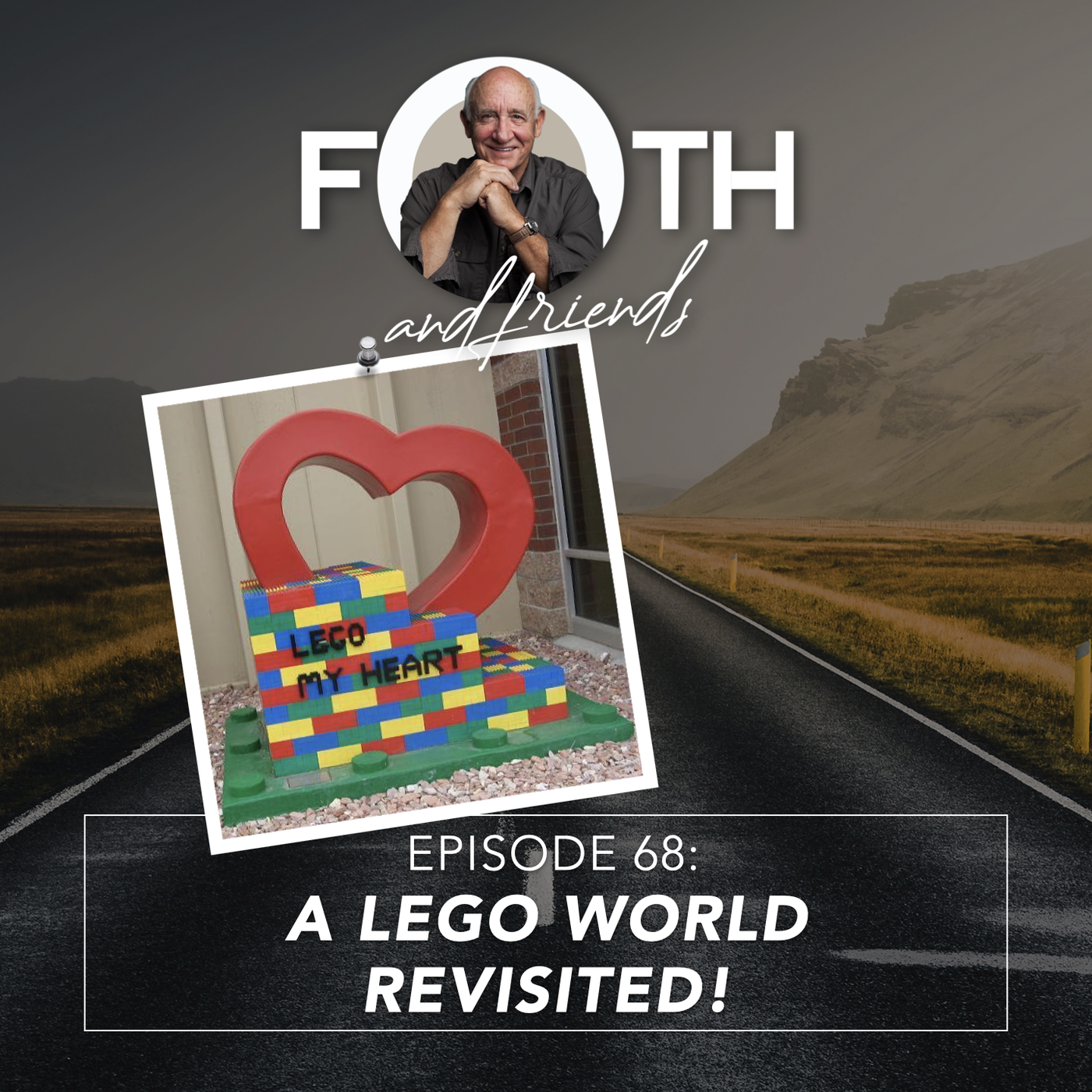
In “A LEGO World Revisited!”, Dick Foth reflects on the humble beginnings of LEGO and uses those familiar building blocks as a metaphor for life, relationships, faith, and communication. From creativity and patience to the power of words and the nature of God as Creator, this episode invites listeners to consider what they’re building—and what foundations truly matter. A thoughtful, story-rich meditation on how small pieces, faithfully assembled, can shape a meaningful life.
-
The surprising origin story of LEGO and why it resonates across generations
-
Why building blocks—whether toys, skills, or words—matter
-
The fundamentals that shape bodies, relationships, leadership, and faith
-
A personal reflection on words, stuttering, and the power of language
-
God as Creator vs. humans as makers—and why that distinction matters
-
A closing reminder: when you speak to the Creator first, every other conversation changes
Theme: Foundations, words, creation, and the quiet power of faithful building
I'm sitting in Colorado and it is the first week in February when you're listening to this no doubt. And the east coast is being inundated with snow and freezing rain and unseasonable temperatures and events from what I understand. And we're here in the High Plains of Colorado still waiting for really measurable snow. But that's how life is. And this is the winter time. And I feel like I need to have James Taylor singing in the background that I'll song in the bleak midwinter. But I just have something I want to chat with you about today. And I'll start with this. How about this name? Do you know this name? Charlie Kirk Christensen. And you say, who is that? Well, not exactly a household name. Is it? He was a Danish furniture maker, made tables and chairs and so forth, back in the last century. And during the Great Depression in 1932, in his carpentry workshop, he began to make miniature versions of his product, little tables, little chairs, so forth, which inspired him to produce toys. A couple of years later, he came up with a name for his company. And since these were toys, he took two Danish words that mean play well, and the words are leg got, and he contracted them, put them together. And when you do that, you have this word that many of us, most of us, perhaps, know, let go. In 1947, after World War II, when injection molding was introduced to Denmark, Christensen bought an injection molding machine for the company to make toys. And within a few years, we had Lego bricks. I understand from a friend that found not too far from where I'm sitting, Loveland, Colorado. There's a company that had a contract to make these since the late 1960s. We've all seen them, haven't we? Ruth and I were driving west on I-70 interstate some years ago, stopped for a cup of coffee and beaver creek, Colorado, which is sort of a high-end community, walked into the main area, which was like an open plaza. And there was a Mercedes-Benz, which is not unusual for beaver creek, Colorado, except it was made out of Lego, the whole car was made out of Lego. Some of you parents have felt them in the night. You got up to take care of a young child, and you stepped on one of those things in the night, and you'll not forget that soon. My question is, why is Lego so popular? Well, anyone can do it. I mean, kids, teens, adults, there's an acronym like FOMO is fear of missing out. There's an acronym for Lego players, older ones, it's called A-Fall, adult fan of Lego. And why would adults like it? Well, it has complex sets, it's nostalgic themes, perhaps Star Wars, they're thinking of the 1970s and the first movie they saw. It's display worthy like the beaver creek Mercedes, and sometimes you just want to create a outlet. Anyway, adults like it, and this company continuously launches new sets. Lego is the most valuable toy brand in the world. Revenue last year, I think, was $5 billion plus the profit over $1 billion. My question is, why do parents like it? Well, parents like it because it's screen free. Screen free engagement would be the phrase. It's engaging for the children. It's a non-digital activity. It fosters three things, at least creativity, problem solving, and patience. What parent wouldn't like that? The essence of Lego is this. These are building blocks, these little rectangular pieces, little square pieces that have those protrusions, knobs, I'll call them. It's like the coolest metaphor for life, isn't it? I mean, think about the building blocks that are necessary to life in almost any arena, like our physical bodies, a building block for our bodies, the brain, heart, nothing works with that brain or heart, lungs, oxygen, nothing works with that oxygen in your body. You've got those gazillion blood cells red and white racing around your body every moment because your heart beats today somewhere between 90 and 100,000 times. Organs name the organ, liver, kidney, bones, building blocks. In certain arenas, like academics, take teaching, for example, what are the building blocks for being a great teacher? Well the teacher has to love the subject, has to love the student, and has to be willing to structure so creativity can follow. And also I think affirm the small steps. Now, if you're a coach, I heard it said some years ago that coaches are the tribal chieftains of our culture of our day. In sports, coaches create a winning culture through consistent practice and teaching fundamentals. I was talking to a basketball coach some years ago and said, what's the difference between this level of play and that level of play in certain leagues and certain entities in basketball? And he looked at me and simply said, footwork, Nick. Well, and when you listen to people talk about football, super balls coming up, it's just a few hours actually. And you hear it talked about all the time, whether it's linemen or quarterback, what's the footwork? How does that work? Fundamentals. So when it comes to what makes relationship work, building blocks, communication, simple as that, no family works without it, no business works without it, country, city, states, military teams, whatever. And communication comes in at least three ways. Body language, it's a big one, tone, it's a huge one. And then there are these things called words. Why words? I mean, you can go back eons and end up with hieroglyphics on cave walls and all of that. But then you have written language, spoken language. But words are the little bumps on the Lego bricks, my image at least. They are the connectors. Words help you exchange information, feelings, and sort of relate meaning between individuals to build, maintain, and navigate relationships. I mean, I was in a store not long ago and some little boy was frustrated or hurt or then was screaming. And I heard his mother say, Johnny, use your words. How many times have we heard that or said that? The challenge is we are a culture flooded with words. We are absolutely in a date. I'm you listening to some now, right? We're just in a date with all kinds of words, all kinds of tone, all kinds of approaches. I just like to take a few podcasts going forward and speak in defense of words. So, I'm an apologetic for words, you say, why would you do that? Well, maybe it's because I really do value language from age five to about 28. I was a stutterer, especially I had trouble getting started with sentences. And when I went to speech therapists, they would say things like you think in paragraphs and are trying to speak in sentences and it's jamming up behind your teeth or something. But years ago, after our children were born and our eldest daughter, we were having a conversation and she didn't say this in a derogatory manner. She just sort of observed, she said, Dad, I think you like the feel of words in your mouth. And I was outed, I guess, you know, why would you want silence when you can silence when you can throw some words in there? But over these next few podcasts, I'd like to make a case for this, words matter. Words matter. And when you look at scriptures and New Testament, there's this line, there's this thought brought by Jesus of Nazareth that says, out of the fullness of the heart, the mouth speaks. Words express feelings, attitudes, approaches, content, all of that. So I just want to start at the beginning real quickly. And when you think of this scripture and many of you perhaps have looked at what we call the Bible, these 66 books with 40-some authors over, but together, it's actually kind of a library over 1600 years. And it starts this way. It begins this way in Genesis 1-1. In the beginning, God, there's a word, created the heavens and the earth. If I were to start with God, we would spend, you know, the next 38 podcasts just trying to say, OK, how does that work? And I think in these podcasts, I try kind of to do that in a variety of different approaches and angles. But when it says, there's a God, then I get to choose, don't I? I get to say, well, really? I'm not so sure. I think I'd like to be my own first time I was really invited to speak on the University campus back in the late 1960s in Urbana, Illinois, University of Illinois. I was invited to a dorm lounge and I gave a little talk and so forth. And one of the things that came up was the subject of God, like, is there one apart from me? And I say, you know, my problem is, as a human being, when I try to create a God, if you will, I create the very best human being I can think of, and then I tend to fall down and worship me. I found out I wasn't wired to be my own God. But if you come to the conclusion, there's a God somewhere of some kind, apart from yourself, apart from myself, then we've got to discover who that is or what that God is like. And that's why I like reading scriptures. But look at the second word. The second word is create in the beginning God created. And there's a Hebrew word for that and it's a short word and it's a barah. It means to create or fashion something new, something fresh or perfect, often out of nothing. Scholars call this in Latin X and the Hilo, out of nothing. But that word in the scriptures is always, virtually always associated with God. It doesn't say man, barah, it's God created. And when you look at it, even in the songs of scripture like King David and Psalm 51, King David had all kinds of skills he had been chosen and anointed and all of that. He was a leader of men. He was a powerful warrior. He was a songwriter. In our day, he would have been James Taylor, played the guitar and wrote songs, you know. And he says after he did some really pretty horrific things and he was a broken man. He says this create barah in me a clean heart oh God. I can't clean up my own heart, only you can do that. That word is used 54 times, just in the Old Testament, just in the Hebrew writings. But the opening and closing books of the Hebrew Old Testament and the Greek New Testament together affirms something key to our lives, one of the building blocks, a core building block. And that is God created. What's interesting to me about this is that when you think about, okay, well, am I a creative because we use that language, we say, oh, those are the creatives, we mean artists and so forth. In a very profound sense, that word barah is never used for humans. It's used for deity. The word that's used for humans is a sa and it means to make something out of something. Well, I can make something out of something and, you know, Scripture says, well, that's precisely the point. God is the creator, something from nothing. And you, both, are a maker and he wants us to be makers. He wants us to be people who produce. He wants us to be builders. He would like us to put together structures that have building blocks that bring life. I don't know whether you've ever said this, but I've heard this a lot. We often have heard words are cheap. And what we mean by that is that that dudes all talk no action, you know, put some, show me some actions then I'll believe your words. I'm just here to say that God is not a cheap word, unless you're used to using him for a comma when you're ticked off. It's not a cheap word. And create is not a cheap word. Those are, those are strong, fundamental, hopeful words. I would suggest that God and create our building blocks for our lives. I'm sort of like spiritual Lego if I put it that way. Many of you have heard me say something like this before back in the 1990s, mid-90s, when Ruth and I first went to Washington, DC, I was going to go meet my first senator. I'm a kid from East Oakland, California, and I didn't go to Harvard, I would have liked to have gone to an Ivy League school or some other place. But I didn't, and I was lower middle class, so I didn't have status economically, necessarily. But over the years, I've been privileged, very fortunate to learn things and be with people who have themselves become building blocks for my life. And I was sort of whining to God praying as I was walking through one of the Senate office buildings. I think it was the Russell office building going to meet my first senator. And I'm saying, so what do I say? Like that. And I felt impressed by God Himself. I'll be so bold to say that. It wasn't me, I'll tell you that. When you speak to the creator or when you speak to the king of the universe in the morning, it's not hard to speak to United States Senator in the afternoon. Let me say it again. This was the phrase, when you speak to the king of the universe in the morning, it's not hard to speak to United States Senator in the afternoon. Maybe I could paraphrase it for this podcast and say it this way. If you speak to the creator in the morning, it's not hard to speak to a modest to maker, no matter position, rank, or title in the afternoon. One more time. If you speak to the creator in the morning, it's not hard to speak to a modest maker, no matter, position, rank, or title in the afternoon. Well, that's it for today. Thanks for listening. If you want to hear some more building block stories, just slide over to dickfoad.com and you know, I'm over there liking the field of words in my mouth. You can find audiobooks on audible Spotify, Apple Books, but then they're called stories I love to tell. That's it for now. God bless. Have a great week and we will catch you later.