

 Apple Podcasts
 Spotify
 Youtube Music
 In Flanders Fields
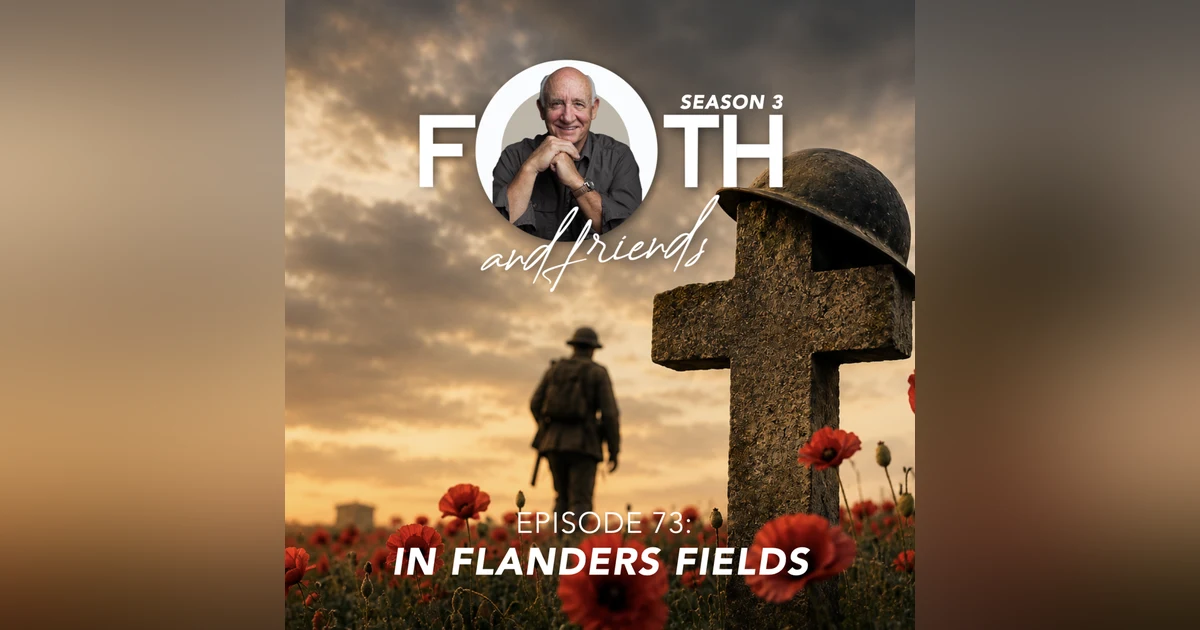

A Memorial Day Reflection on Sacrifice, Remembrance, and Freedom
As Memorial Day approaches, Dick Foth reflects on the power of memory, sacrifice, and gratitude.
In this moving episode of Stories from the Road, Dick explores the origins of Memorial Day, the lives behind the tradition, and the enduring meaning of remembering those who gave “the last full measure of devotion.”
From the Civil War roots of Decoration Day to the haunting beauty of John McCrae’s famous World War I poem In Flanders Fields, this episode reminds us that freedom has always come at a cost — and that remembrance matters.
A thoughtful reflection for Memorial Day weekend on leadership, sacrifice, honor, and gratitude.
Episode Summary
What does it mean to remember well?
In this Memorial Day episode, Dick Foth reflects on the importance of memory — not just personal memory, but collective remembrance. He traces the origins of Memorial Day from the Civil War era through its evolution into a national day of honor for fallen service members.
Dick shares reflections on leadership and sacrifice, recounts conversations with national leaders about the qualities of true leadership, and closes with the powerful story behind Lieutenant Colonel John McCrae’s World War I poem, In Flanders Fields.
This episode is a tribute to those who gave their lives so others could live in freedom.
Chapters
00:00 — Introduction: The Meaning of Memory
00:37 — Remembering in Scripture
02:05 — The Origins of Memorial Day
02:57 — Decoration Day and General John Logan
03:29 — Why Memorial Day Matters
04:15 — Freedom Isn’t Free
05:03 — Leadership and Sacrifice
05:57 — World War I and Trench Warfare
06:24 — John McCrae and Alexis Helmer
07:07 — The Red Poppies of Flanders Fields
07:30 — “In Flanders Fields” Poem Reading
08:54 — Gratitude for the Fallen
09:35 — Closing Thoughts
Key Themes
- Memory and remembrance
- Memorial Day history
- Sacrifice and leadership
- Gratitude for military service
- World War I reflections
- The story behind In Flanders Fields
Well, hello again. This is Dick Foth with stories from the road and this story is created on a fine May morning, actually just coming up to what we call Memorial Day weekend. Isn't memory a fascinating thing? As I've aged, I said, where did those names go? Where did I leave that thing or how does that work? I'm not talking about memory in that particular way. There is memory loss because of incapacity, but there are some memories because they're put on calendars that remain as days of remembrance, whether it's birthdays or anniversaries or baptismal dates or whatever it is. And Memorial Day has a unique genesis and a unique place and a unique place in America's history and the history of other English-speaking nations as it turns out. But going back before that, of course, you have the scriptures. There are lots of scriptures that talk about remembering. Here are three. Remember your creator in the days of your use before the days of trouble come in the years approach when you will say, I find no pleasure in them. There's no need to get personal here, right? How about this one? This is Yahweh speaking to the Hebrew people. Remember that you were slaves in Egypt and that the Lord your God brought you out of there with a mighty hand and an outstretched arm. Or this one encouraging people toward generosity. Remember this, whoever so sparingly will also reap sparingly and whoever so generously will also reap generously. So just to frame these next few moments, let me ask this question and it's a question about names. What do the names, Marianne Williams, John Logan and John McCray have in common. Either directly or indirectly, three of them, all three, are connected to Memorial Day. So Memorial Day is this occasion when we honor and mourn those who gave their lives in the defense of the United States. I think the phrase that is used most often is the last full measure of devotion. And Memorial Day as we know it was first called decoration day and was to be observed on May 30th and it was first done in 1868 after the Civil War, ostensibly to honor union soldiers but a woman in the south whose husband had been lost to the war. Her name was Marianne Williams and she urged women to set aside a day to decorate the graves of fallen soldiers. Later that day was instituted by the chief of staff of the US Army, General John Logan and most states then adopted that date. And some folks say why did he choose that date? And some believe or the common belief is that he chose it because it's the time of year when most flowers bloom. So the term Memorial Day then was first recorded in the 1880s, increasingly popular after World War II, but it really didn't get on the calendar if I can put it that way until 1968 by an act of Congress. And the day was May 30th, went from May 30th to the last Monday in May. This idea of remembering those who have paid the ultimate sacrifice so that we could be free, so that I could do this and you could listen without impunity or without problems is such a tremendous gift. We often say it freedom isn't free. The price was paid by someone and all you have to do is walk the length of the Washington Mall from Lincoln Memorial to the Capitol to see all of the references to people who have given their lives so that we could enjoy freedom. When I think of it, the piece that comes to mind for me or the moment that comes to mind for me was when I lived in Washington D.C. And about two or three weeks apart, I asked two leaders. One was a member of the president's cabinet, president George W. Bush back in the day, and the other was a retired three-star general, and I asked them, what do you see as the most significant quality for leaders or of leadership? And both of them, independent of each other, said one word, sacrifice. The one who leads the charge up the hill, the one who takes the hit, the one who pays the price, that person is a leader, so we have hundreds of thousands of leaders whose bodies lie in cemeteries across this country and in some cases across the seas, for whom we need to be grateful on this Memorial Day weekend. There's one particular piece that I'll close with. It was World War I, which was a horrific war that was trench warfare, just bloody and brutal and muddy, and if you've read anything about World War I, they said it was the war to end all wars it wasn't, but it should have been. And at the second battle of EEP, there was a Canadian medical doctor, Lieutenant Colonel John McCray, who was not serving in the medical core. He came from Guelph, Canada, and he had signed up even though he could be in the medical core or in a medical unit. He signed up as part of a fighting unit, but as a medical officer. And on May 2nd, a good friend of his, young man Alexis Helmer, was killed in that battle, May 2nd, 1915. John McCray was a soldier, a physician, and a poet. And what had happened is with all of the bombing and all of the explosions that went on in trench warfare, the earth at deep levels was heaved up in the air, and when that happened there were dormant seeds from red poppies that were unearthed and started to grow because they hadn't grown there apparently for some years. And when John McCray's friend was killed that day, he was asked to do the internment service, and he wrote a piece of poetry that became famous after that. It's called in Flandersfield. This is how it goes. And he's sitting apparently on the back of an ambulance looking out over the newly dug grave of his that held the body of his young friend with a simple wooden cross and lots of wooden crosses there and amidst them just a profusion of red poppies, blowing in the wind. And Flandersfields the poppies blow between the crosses row on row that mark our place, and in the sky the larks still bravely singing fly, scarce heard amid the guns blow. We are the dead. Short days ago we lived, felt dawn, saw sunset glow, loved and were loved and now we lie in Flandersfields. Take up our quarrel with the foe to you from failing hands we throw the torch, be yours to hold it high, if he break faith with us who die, we shall not sleep, though poppies grow in Flandersfields. On this weekend and in these days when we remember the fallen who have paid the last great measure of devotion so that we can be free, we say to them in absentia if you will. Thank you for your valor. Thank you for your presence at a moment in time when often as young men or young women you lost what would then be a long life. We stand in awe of that. We are so grateful. That's it for today, but we will keep remembering. God bless