

 Apple Podcasts
 Spotify
 Youtube Music
 ALIVE! And, GRATEFUL!!
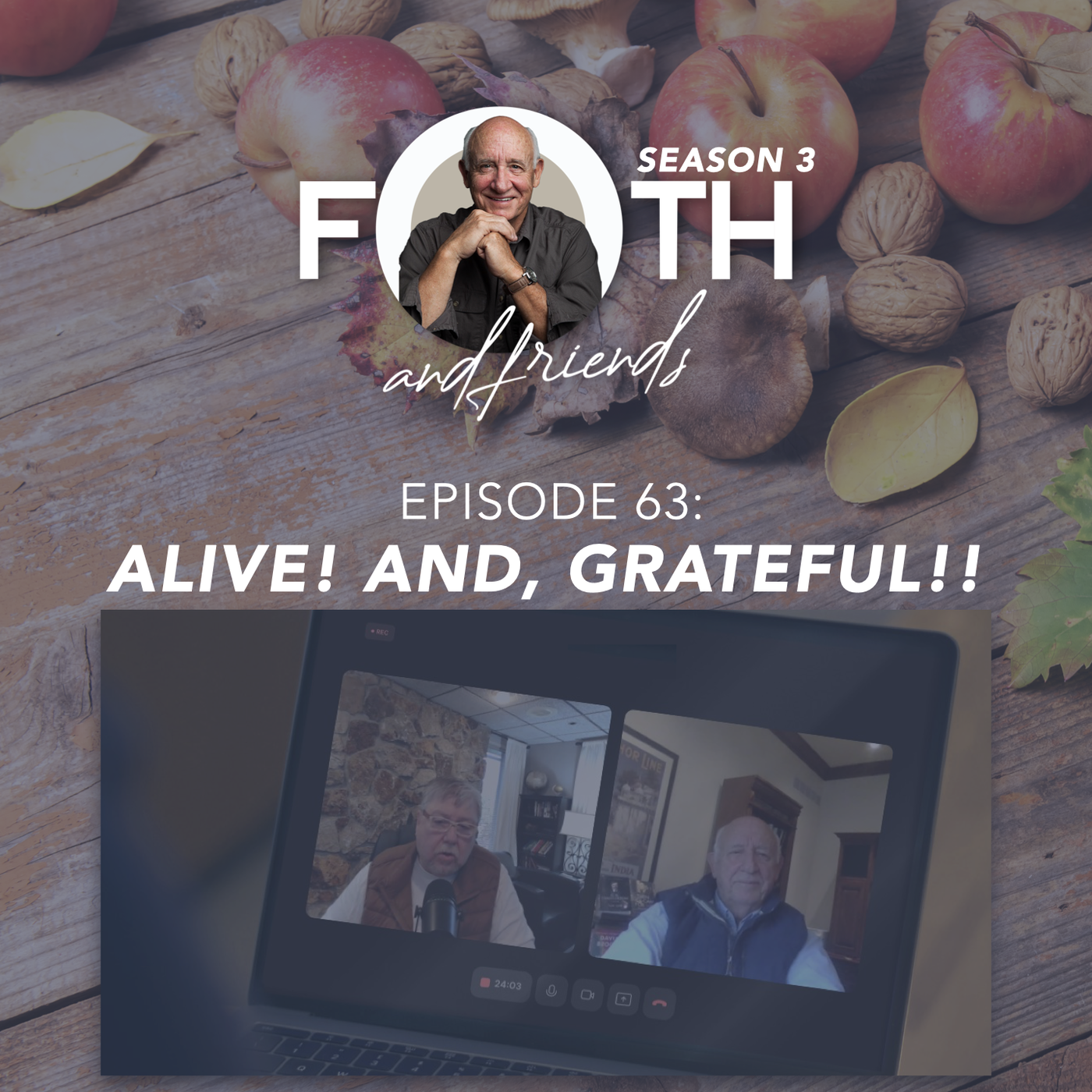
In this Thanksgiving-week conversation, Dick Foth and his son-in-law Van Clements explore the deep, practical, and spiritual power of gratitude. From stories about grandchildren and family patterns to reflections on scripture, psychology, and culture, they unpack what it means to live gratefully in a world often marked by stress, negativity, and distraction.
Van shares how becoming a grandfather has shaped his desire to be a “non-anxious presence,” and how simple relational moments with his grandkids have become powerful reminders of God’s goodness. Dick reflects on the joy of beloved faces, the impact of intentionally grateful thinking, and the biblical call to “rejoice always” — even from a prison cell, as Paul writes in Philippians.
Together, they offer grounded, practical encouragement: gratitude must be intentional, cultivated daily, and practiced especially at the table with family and friends. Their hope is that this Thanksgiving (and beyond), listeners will slow down, savor simple gifts, and choose thankfulness.
1. Gratitude Is Relational
-
Van’s gratitude is anchored in time with his grandkids — being present, listening, creating calm, and loving well.
-
Simple words of affirmation (“That’s the face!”) create powerful emotional connections.
E63_S3_Gratitude_Pod
2. Being a “Non-Anxious Presence”
-
Van’s life goal is that his grandchildren want to be with him.
-
Children quickly discern authenticity; gratitude helps adults show up more peacefully and lovingly.
E63_S3_Gratitude_Pod
3. The Visceral Power of Faces
-
Dick reflects on the joy that comes from seeing a loved one’s face — and imagines God delighting in ours from infancy to old age.
E63_S3_Gratitude_Pod
4. Gratitude as a Cultural Remedy
-
A friend’s phrase: “I’m alive and grateful.”
-
Gratitude counters stress, improves longevity, and reshapes negative thought patterns (referencing Mark Batterson’s “Win the Day”).
-
Without intentional gratitude, our minds default to negativity.
E63_S3_Gratitude_Pod
5. Family Practices that Build Gratitude
-
Dick’s wife Ruth used to ask their kids at dinner: “Tell me one thing you’re thankful for today.”
-
Van shares a parenting technique where siblings must hug and say positive things when they’re in conflict.
E63_S3_Gratitude_Pod
6. Scripture’s Call to Gratitude
-
Paul, writing from prison, urges believers to rejoice, reject anxiety, pray with thanksgiving, and think on what is true, lovely, and admirable (Philippians 4).
-
Peace becomes a guard over our hearts and minds.
E63_S3_Gratitude_Pod
7. What We Consume Shapes Our Gratitude
-
Van shares how stepping away from Facebook changed his thought patterns.
-
Social media often overloads people with negativity and opinions we weren’t designed to carry.
E63_S3_Gratitude_Pod
8. Gratitude Requires Intentionality
-
It must be stirred up, practiced, and chosen — especially in stressful seasons like holidays.
References Mentioned
-
Philippians 4:4–8 – Paul’s exhortation to rejoice always, be gentle, reject anxiety, pray with thanksgiving, and think on what is true and lovely.
-
Mark Batterson, “Win the Day” – Reference to research on the average number of daily thoughts and the predominance of negative thinking.
-
“Third Street Church of God” in Washington, D.C. – Pastor’s weekly refrain: “I’m alive and grateful.”
-
Dr. Bill Malarkey – Insights on gratitude as the antidote to stress and a factor in longevity.
Well, here we are again, folks. This is Dicphoth with stories from the road. And a lot of you may be on the road, because this is Thanksgiving week. This is the time when people travel. And we're glad now that the shutdown's over. Maybe the planes are going to fly. It's going to be tough enough that Thanksgiving week to fly anyway. And here we are often, often running or wheels up, whatever it is. There's something I have a thesis about Thanksgiving, by the way. My thesis is that more people travel on Thanksgiving than Christmas. And that you just take yourself and your appetite. You don't have to take presents. It's just so much easier just to do Thanksgiving that way. And in other Thanksgiving podcasts in years past, we've talked about the early years in this country when Thanksgiving came to be as a celebration that we identify or Lincoln's Thanksgiving proclamation and other things like that. But think about it. Who would you rather be with and around in your life than a thankful person? I mean, it's just it's just a no brainer. Nobody nobody wants to say, well, I think I just like to go out today and meet three or four in grades. So, but speaking about thankful people, I'm thankful that I get to do a third podcast with my son and all and Clemens from Eugene Oregon. There you are again, man. Great to be here. And I'm thankful to be able to talk about this. It's a big deal in our culture right now. So. So I got a couple of verses from the New Testament that I want to read in just a few moments. But when I say the word thankful or grateful, what just comes to mind for you? Just give us a couple of minutes on your. You know, the first thing that comes to my mind, when I think of thankful, I'm thinking of my grandkids right now, because the joy of watching them become who they are. And when they're born, they're exactly who they are. And you just see that continue to blossom as they get older. I have five of them now, which is unthinkable. So you're you're you're a grandfather holder, even. I'm 57. And your grandkids are held Emma is eight. Avery is five. Owen is four Stella is two and Nora is two. And they are amazing. And I have a new golden life is to be a non anxious presence such that my grandchildren would want to be in my presence. That they would want to be with me and be near me. And because I feel like if I'm able to do that for them, then I might be able to be a non anxious presence for you. Because kids are discriminating. They don't put up with your, you know, your fake or your junk or your loudness or your charm. They just they they understand they're like a they got extra sensory power. And I look at Erica when I think of gratitude, I look at Erica when the kids are Erica, Erica my wife, you're your eldest daughter. Thank you for that. By the way, I'll look at her and smile. And she knows what I mean. Somewhere near the end of our time, those grandkids end up with me on the couch. Sometimes are sitting on my head, sometimes sitting on my lap. And usually we've engaged in some conversation, some story, some thought. And it is the most fulfilling, thankful moment that I can think of right now outside of someone coming to saving faith in Jesus. That's pretty incredible too. As a man as a grandfather, this moment that my prayer, my desire to be a non anxious presence that it's happening right now. And sometimes all five of them will be because once one gets up, they all want to get up. And it is the most thankful I can feel right now. Like I'm so thankful God that you have allowed me this privilege. Tell our listeners that that story that you told about I can't remember which one it is if it's Avery or somebody who came and you said something about that face. And you remember the story I'm asking you about. Yeah, Avery is the second born. She is five years old and she is just delightful. Her life is a musical. Wherever she's at, she's singing on her own. She's dancing. She's got something going. She's got a script flowing. And it's usually a big musical. But I say to her all the time is I'll see her and I usually try to get on her level and look her in the face and I go look over here. And she'll look at me. I said, that's the face. That's the face. I can't get enough of that face. And she just, words of affirmation are her love language. She just blossoms. And so a couple of about a month ago or so she jumped up in my lap in the living room and she looked at me kind of side eyed me and she says, here it is. And I go, what? She goes, here it is. I go, what do you mean? She goes, the face. And I was undone because here she was presenting the face that I can't get enough of right on my lap. And I just thought it was the greatest thing in the world that she wanted to engage that way with me and say, Papa, here's the face. That's the face you can't get enough of. And I just thought, man, I want to be a child like that. Do you remember the song again from the last century? I'm starting to like saying that. I grew up mostly in the last century. But do you remember that song? I can't remember who the first time ever I saw your face. Do you remember that? That's that idea of the joy that comes from a face that you love because you're looking at a face that could be teary, you looking at a face that could be smiley, anticipating whatever it is, but there's something about that. I'd like to think that God Almighty, the creator of the universe, when I go to Him and I'm talking to Him, right? And I have a feeling like He's saying, you know, I liked both. I liked that face when you were one and a half or when you were three. I still like it when you're 83. It's okay. It's good. It's a good face. There's something about that that is so visceral. Maybe that's the word I'm looking for. It's so at the heart of people. That's why zooming, let's say, or face timing for younger people is better than just talking on them as good as talking on the phone is. I know what a great gift that was 100 plus years ago. When the telephone came on, right? But that's a plus. You know, the idea of gratitude is it's central to humanity that when people are grateful, not just for what they receive, but just grateful to be alive. On any given time, and it's hard to think of people in the hard places, Ukraine and Gaza and some of these places that are being grateful. That idea is so profound. I have a friend back in DC, a young man who came to faith in Boston years ago in the city of Boston. It's tough, I believe, university. And whenever I see him, I would say, how you doing? And he would say, I'm alive and grateful, no matter where I was, wherever I said, where'd you get that? He said, when I first came to DC, I started going to an African-American church. He's not African-American. He's a white Jewish kid from Boston. And he said, I started going to, I think it was Third Street Church of God. And he said, the pastor would get up in DC every Sunday, every weekend and say, I'm alive and grateful, and the congregation would respond. So it became part of his fabric. That as an instinctive response to the question, how are you, which is oftentimes just a throwaway line? I mean, that'll start a conversation. I was at a men's retreat then years ago at a place called Wendy Gatt, North Carolina. I was one of the speakers. And one of the other speakers was a fellow named Dr. Bill Malarkey. Wonderful. That's got to be a wonderful Irish name. And Bill was retired as a medical doctor and a specialist in genetics and in aging. And he wrote a book, sort of self-published book on joy. But one of the things he said is that the antidote to stress is gratitude. And he also said that gratitude is directly related to longevity. And what do you think about that? Do you buy that idea? Just I don't think I've ever particularly said that to you before. But what comes to mind when I say that? Absolutely. Actually, it reminds me of that quote you and I've talked about before from Mark Patterson's book, When the Day Where He Talks About the Center for Thought in Cleveland. Cleveland Center for Thought says that you and I have 60,000 thoughts a day. And in any given day, 45,000 of those thoughts are negatives. And we repeat 90% of our thoughts from day to day. So if we begin to intentionally think grateful thoughts, say grateful thoughts, live grateful thoughts, it is going to change the way that we think and live. I mean, so I think we live in such an interesting time where we've all become accustomed to the fact that our opinion matters. And it does, but not as much as we think it does or act like right now. And if we stopped to be grateful for the things that matter most right now, it would be the most significant things to change our lives, our conversations, it would change your Thanksgiving dinner table. It would change what you talk about because it's usually at moments of difficulty or stress or even the death of a loved one where people get grateful again because they realize that all the other stuff doesn't matter. How do we get to that place quicker than when a tragedy or difficulty comes? How do we get to the place where we say, you matter more than my opinion about said political stance or whatever? You know, it's interesting, your mother-in-law, my lonely wife Ruth, when the kids were small, when Erica was small, in the other three. Oftentimes at the dinner table, she would say, tell us one thing you're thankful for today, what happened today or just something you're thankful for. And it became sort of a baseline for, you know, I'm over there saying, sit up straight and chew with your mouth closed because I was raised in a British boarding school, right? So that's my gig, and she would say, tell me one thing that you're grateful for. It's interesting. We had to, I'll tell you something that triggered something in my jukebox. The other day, I got a picture from Allison, our oldest daughter and her two girls, Emma and Avery who are eight and five. And they were standing in the middle of their living room hugging each other. And she goes, Dad, I'm employing some of your tactics. And it's something I learned from my dad when the kids, she said the girls have been going at it all morning, just everything's wrong, touching me, smelling, you know, whatever. And so she goes, I made them stand in and hold each other for two minutes in the living room. And so you can see them and they're both like us, you know, very, not very into the hug, you know, but they're sitting there. With Claire and Allie, when they were younger, because they were just talking and so negative and just picking at each other. And so I said, well, you need to go to the next tactic and say, now say five things you like about each other. And so Claire, our younger, our middle daughter jumped in and she goes, I used to say the dumbest things. I would say, I like your shoes, Allie, I like your shirt. I never said anything nice, but it was like one of those things you have to be forced to do something. And pretty soon as they're holding each other, hugging each other pretty soon, they would start giggling and laughing and tickling each other. And all of a sudden they would break down that negativity that they had developed. And I just think sometimes we have to be reminded. Well, I think when I read Scripture and the New Testament, I'm reminded in the letters that Paul wrote, here is this guy who was essentially religious terrorist for the first part of his life and then had this moment in time that totally changed him. He's up walking most scholars think he walked about 10,000 miles back and forth across what we call Turkey now. And there's one time he's wanting to go places and the spirit is as preventative and he ends up over in a town called Troas. And out of that, he ends up going across the sea right there to Philippine, which back in the day was a central town of the Roman government. And it's what we would call Europe today. It's where the good news got to Europe right there. He ends up later. He's in prison. And so it's not a good time. It's stressful time. He's in prison and he writes the folks at Philippine note a letter. And you get to the end of it and it says it says this. And again, here's a guy either in chains at least under house arrest. Maybe handcuffed to some guy. We don't know. Rejoice in the Lord always. I'll say it again. Rejoice. The Lord let your gentleness be evident to all. He's shackled. He's in a Roman prison and he's talking about gentleness. He says let your gentleness not not your point of view, not the place you think you're right. Let your gentleness be known to all. The Lord is near. Do not be here we go. Do not be anxious about most things. No, it says about anything. But in every situation by prayer and petition with Thanksgiving. Present your request to God and the peace of God, which transcends all understanding. It's transcends all understanding will guard your hearts and your minds in Christ Jesus. He's standing here. He's in the man routine prison in Rome, I think, which is underground today. If you go there, you can see it's not a big space. He's got two guards and he says speaking about guards, how about letting peace be your guard and the way you get to peace is being thankful and all things and presenting your needs to God. And then goes on to talk about the positives. Finally, brothers and sisters, whatever is true, whatever is noble, whatever is right, whatever is pure, whatever is lovely, whatever is admirable. If anything is excellent or praiseworthy, think about such things. You know, my greatest, the greatest challenge for me, the greatest battlefield and the greatest quagmire oftentimes or the greatest productive is the five and a half inches between my ears. And if I get up in the morning and start thinking, so what's admirable, like what really is true and that's challenged today, no one what's true, unless you have a true north, like we believe we do in following Jesus and we've got scriptures and so forth. True is a hard deal today. Whatever it is, that has to help you. You know, I'm looking outside my study window and the leaves have gone off the little mulberry tree. I think no, it's a crab apple tree. No, anyway, whatever it is, it's right outside my life. And the leaves are all gone, but there are red berries on it. And I'm looking at some hydrangea blooms that have gone from green to white, now to greenish rust color and a bird landed in the tree. And those are simple things. But to be able to think on this November day is we approach Thanksgiving tomorrow. I think it's coming out on Wednesday. To think about when we sit around a table and we sit hopefully with someone that we care about or several someone's we care about, let's think about ways to think of like five things, even if you thought of two things. So yeah, anyway, what do you think it is an exercise? It's something that you have to stir up within you. Intentional gratitude does not come natural for us. We tend to live for ourselves naturally. Maybe the whole fall had something to do with that. But it's something that you have to intentionally do. And it's it's so important. And I think it's it's not fun. I was I was with some friends recently and I and I just thought, boy, they're just in a hard place. They're just nothing. Nothing that came out of them felt positive. It felt hard and and I just thought, wow, maybe maybe I've been there too, where I don't feel right. And so I just see things through a negative lens and I just spew stuff. And honestly, I actually went off Facebook about a month ago and it's changed what I think about because I'm not reading everybody's spew. And I don't think we were designed to handle everybody's opinion about everything. I think the one thing that social media does is detract from our ability to see what is true and what is lovely and what is excellent. It's great. Now I love hearing about people's vacations. But it's I always said it's like when you go to social media, it's kind of like having a bowl of dog food and eating it and then finding a nice piece of grilled chicken in there. And then there's an M in M over here. And then here's a nice little piece of French bread. But you've and when you're done, you have eaten a bowl of dog food. And it's been a few nice things in there. But the most of it is just not worth consuming. So we got to change what we take in because if it affects what comes out of us. So whatever is admirable, whatever is lovely, whatever is true, whatever is good. Let's think about that tomorrow as we say. So I got one last thing to say to you, Van, you ready? What's that? Thanks for doing this. Thank you. And thank you folks for listening. And if you have a chance to rate and review this podcast, it'd be great. God bless you will catch you next. Oh, one thing before we go. And that is we're going to do an Advent series upcoming here in in December. Some things that will take that Thanksgiving and focused on a particular moment in time in real time and history that changed the world. And we'll look forward to being with you there. God bless, catch you later. you