

 Apple Podcasts

 Spotify

 Youtube Music
9/11: From the Ashes – "Hope"
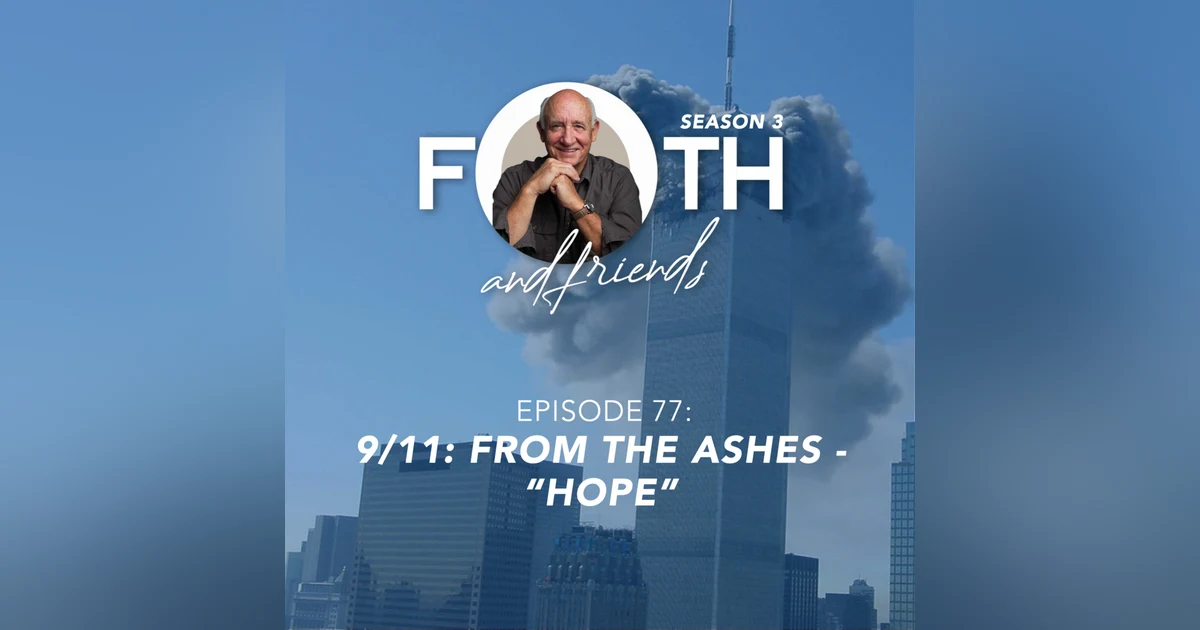

Twenty-five years after losing his older brother in the South Tower on September 11th, Craig Woodall — a retired 30-year high school educator and principal from Fort Collins, Colorado — joins Dick Foth to talk about the long road from grief to hope. Craig walks through the last phone call he ever had with his brother, the agonizing wait for news, and the seven months he spent "running from the storm" before a single, unmistakable moment turned him around. Using the image of a buffalo that faces into a storm instead of fleeing it, and anchoring everything in Romans 5:3-4, Craig unpacks how suffering can produce perseverance, character, and ultimately hope — and how one small word, "yet," can change the trajectory of a life. It’s a conversation about loss, faith, family, and the quiet, daily choice to let hardship develop you instead of define or defeat you.
Chapters
- 00:00:00 Introduction: Meeting Craig Woodall
- 00:01:39 The Buffalo Metaphor: Charging Into Storms
- 00:02:45 September 6, 2001: The Last Conversation
- 00:04:25 September 11, 2001: The Day Everything Changed
- 00:07:52 Running From the Storm: Seven Months of Grief
- 00:08:46 The Holy Spirit Moment: Pick Your Head Up
- 00:10:20 His Niece: A Legacy of Hope
- 00:12:35 Romans 5:3-4: The Path Through Suffering
- 00:15:00 Building Hope: Daily Practices and Mindset Work
- 00:17:07 Define, Defeat, or Develop: Choosing Your Response
- 00:19:31 God Can Redeem What He Did Not Orchestrate
- 00:21:04 Ask Those Coming Back: The Power of Community
- 00:23:41 Overcome: A Book and a Journey
- 00:25:22 The Power of Yet: Transforming Negative Statements
0:06 Well, my friend today is Craig Woodall from Fort Collins, Colorado. Craig, how on earth are you? I'm doing great. Thanks for having me. Well, I heard you speak this past week. And the reason I asked you to do this is that your subject and your focus was so pertinent to this moment that I just wanted to talk with you. And you were kind enough on the spur of the moment to agree to do this. Give us just a little snapshot of who you are, wherever you were born and brought up. Just give us a little of that so folks can know you a little bit. So I'm a 30-year retired public educator, all of it at the high school level, social studies. Last 12 years as a principal, I'm a proud father of four.
0:49 Amazing kids, two that are out of college, one in college, one still in high school, happily married, lived in Fort Collins, Colorado. Yeah, grew up mainly in San Diego and moved to Colorado in 1998 to a degree. I have pretty much stayed ever since. And you're the youngest of three boys. I have an older brother, older sister. I was the youngest of three kids. Youngest of three kids. When you were talking the other day, you just started referencing your brother. But in your talk, you stood up and essentially this is what I heard. This may not have been what you said. This is what I heard that I'm here to talk to you today about hope.
1:32 And then you you gave us an illustration of an animal to sort of get us going. Tell us about that. So they say that Buffalo is one of the only animals that turn and chase and charge into a storm. And they often will do it by joining together with their herd. Cause I know that's so much stronger where most animals, most people just turn and run from a storm. When you run from a storm, that storm really has no end. It just keeps chasing you. It keeps falling. And so the Buffalo, even though it's harder by turning and walking directly or charging into that storm, they're going to get through it much quicker and, You know, when I was dealing with lofts and things, I was anything but Buffalo.
2:13 I was trying to run and hide, needed to truly face the storm. And it's become a theme in my life with adversity that has come. I've tried to learn to face the storm. 25 years ago this month, you ran into a storm and it started for you, I guess, when you walked into the house that day and you wanted to play with, you'd been teaching or whatever, wanted to play with your little girl and your wife said to you what? She just said, hey, call your brother. And I said, no, because I'd been teaching and coaching all day.
2:55 And my brother and I just weren't great phone talkers. We never were better emailers. If we were gonna talk on the phone, I'm gonna go, let's be quick. And when she told me he called earlier that day that I should call him back, then I got something wrong with his marriage or with my parents, with the market or something. So yeah, I just, luckily, took my wife's advice and called him back. So the beautiful part of it is, is he and his wife were calling to tell me they were pregnant with their first child. And so our conversation was so beautiful, but it was very interesting because even though I'm the younger brother, I bought a house first, I had a child first, I was married first.
3:39 So all of his questions were what you normally ask the older brother. And so our roles had kind of shifted where he, you know, what is it like to get up every night? How could you pick a name? How are mom and dad as grandparents? All these kinds of questions. we talked about what we wanted to be with our kids. So we want to coach them in little league. Were they going to be athletes? Are they going to be musicians? And just an unreal conversation that we didn't have very often. I'll be honest. We didn't talk like that very much. We would sometimes in person, but not just over the phone. We're both busy and driven in our careers. And it was a beautiful conversation. And then what? So the maybe most beautiful piece of that is that would be the last time I ever spoke to my brother.
4:25 And that was September 6, 2001. And the following Tuesday, of course, was September 11, 2001. Like everyone, I know exactly where I was. I was sitting in a classroom getting ready for the day, saw on the TV what was going on. My brother worked on the 89th floor of the South Tower for a company called KBW Deep Redwoods. And when that first tower was hit, He called out and told my dad, you know, Hey, that's the other power. Don't worry. He literally talked about seeing people jump or fall from the buildings, the amazing things he was seeing, but Hey, it's not my building.
5:08 So don't worry. And then of course, 17 minutes later, a second plane hit. And even just from the being an American and a, and a social studies teacher, just that moment of this is an attack. This is not. accident was overwhelming. Then knowing that my brother was in that power was very overwhelming, but he was a large driven athletic dude. I was, I have no way he's not getting out. I assumed of all people he'd be carrying people out, running back in, carrying people out, running back in. He did call out again, so we knew he He was fine at impact. He left a message for my parents just saying, that was my tower.
5:51 I don't know what happened. There's chaos in here and I got to do all I can to get out. So, yeah, I spent that morning the same way like most people did, watching it play out on TV, just knowing my brother was at the center of it. you had somebody in that building and the building collapsed. And there were, what was the number? 2,977 folks. Was that the right number? 2,977. That passed away. In your description of that and your response to it, You said several things when I heard you speak, and I can't put them in order.
6:35 I did take notes, but I'd prefer that you put them in order, if you would. Just so our listeners can get a track, what does it mean to be a buffalo and face into the storm, if you will, that was this. It's a historic storm, but it's a personal, emotional, devastating, spiritual, psychological. Give us a little track, if you don't mind, to just think about it. Sure. So the unique thing about 9-11, I had experienced other loss in my life, but they were immediate. You know, there was a car wreck, I got a phone call and they were gone. There was no wondering. This you wonder. You wonder not just for the first hour, but for the first week.
7:19 Because after he called out after the second impact, we never heard from him. But that didn't mean he was gone. In fact, I had called him, times that morning and it just rang but then the last time it was just silence and it turns out that the building had just collapsed so it's like there's no way that we're going to get communication even if he's completely fine for a long time and so i i stood in front of the tv trying to find him just searching for him looking around trying to find him for the better part of a few days and when I didn't for the first two days. I pretty much knew he was gone. You know, there's a part of your brain that could text you and says, maybe he's had his amnesia in a hospital.
8:03 Uh, but I pretty much knew he was gone and the analogy of the Buffalo, I just say I ran from the door for months. I just didn't want to think about it. I couldn't think about it. Cause when I did, uh, yeah, numb. I would get angry. I would not be a good dad, a good husband, a good teacher. I still had a job to do. So I, you know, put the teacher hat on and, and it was literally seven months later in April of 2002, which is an interesting timeline. And I didn't share this in the service, but that's also the same time they identified him for the first time was in April of 2002. So we really went seven months to unclear.
8:46 And I had this Holy Spirit moment that brought my world that just said, enough, take your head up. You are not defeated. in a moment realized I've got to do something or else I'm just going to spot a lot of control. So by a Holy Spirit moment, you know, the Spirit is spoken of in Scripture in various ways, one of which is Counselor, the one who comes alongside sort of that old. And the Holy Spirit in that moment essentially said, do you stop it? turn around, stand up, whatever the language is. Is that right? I mean, it's just boom like that. I mean, there's, it's only happened to me four times in my life that I can think of probably half a thousand and I ignored it or just thought it was smart, but for a clear time, this was one of them because I literally was fed down, shuffling my free feet across a cold parking lot.
9:42 As clear as day, it popped in my head and now, pick your head up you are not defeated to the point i looked around like did anyone hear that yeah and it was it was extremely clear and i and i will tell you i did i immediately picked my head up and i say very clearly i was not healed in the moment i was not done grieving i i didn't even started grieving yet but i knew like enough you've got to face this storm if you want to ever be anything for your daughter for your wife for your students for your athletes You've got to face this storm at some point. Here is this new baby, your niece. And now here we are 25 years later.
10:22 And where is she? So she is living in Ireland, of all places. At least that's where she went to school. She's completed two masters. She graduated from Columbia University, played volleyball there. And the last guy connected with her said she was getting ready to start work on a doctorate. Just an amazing thing. It's really incredible. Obviously, she never met her dad. Sure. And then he never met her. How similar two people can be that never met. I mean, she looked like him. She felt like him. She's a strong athlete like him. She would, in the same way that he was a pretty calm guy, until he didn't need to be.
11:06 And then he would flip a switch and he was the most intense guy in the room. And she's a very calm human, very intelligent. And then I see her play volleyball and they set her and she goes up and boom! And she's excited. I'm like, oh my gosh, this is exactly my brother. Now his wife was also a very driven, intense athlete and all those things too. But it's incredible. Quick story, the 20th anniversary of September 11th, I'm back. I'm out there with my youngest daughter who let's see, she would have been 11 years old at the time and getting ready to play volleyball herself. And in Pierce, my niece had a game at Columbia, the night of September 11th.
11:50 So on the 20th anniversary, 20 years to the day, I'm able to sit in a gym and watch her play volleyball in New York city with his widow. And my youngest daughter was an unbelievable moment. My goodness. So many people's lives have fragmenting moments. I mean, some are horrific as this. But the verses that you connected with how you move into the storm are pretty straightforward.
12:33 Romans, the fifth chapter. I loved what you said that you didn't you didn't you weren't good at memorizing scripture growing up. You really didn't come to faith till you were 15. So you didn't get all the Sunday school stuff. So your favorite verse was Jesus wept. And we all chuckled at that. But in fact, that's a powerful verse for a whole range of reasons that you specified. Romans 5, 3, and 4, you can probably quote it for me. Can you quote it for me right out of the chute? Yeah. Yeah. It's rejoice in our suffering because we know that suffering produces perseverance, perseverance character, and perseverance hope. So you got a bad you got what feels like a bad thing.
13:14 I mean, I mean, nobody wakes up in the morning and say, you know, I just like to have 43 pounds of suffering today. Nobody does that. So so suffering will come to all us. People don't identify with our victories. They don't identify with the with the 10 games you won as a football coach or whatever it is. But they absolutely identify with the losses and the sufferings. So here is Paul speaking to this essential piece of the human condition. We all know what suffering feels like. And he does this sequence, which you just quoted. Suffering. is overcome, I'll use that language, by perseverance, which produces character, which gives you hope.
14:02 Do I have that trilogy right? Perseverance, character, hope. Some of the other versions say endurance. Endurance, right. Builds character. And that's open for me. I used to always kind of get frustrated by that because we're just supposed to be happy all the time. We're just supposed to rejoice like, hey, God is good. And when things are tough, God is still good. I struggled with that. And it felt a little fake to me, but it wasn't until I really dug in. It's like he's not giving us, you know, just an easy shortcut to hope and joy. He is telling us things will be tough. And you need to follow this sequence. You need to follow the sequence of learning to persevere, build that endurance, build that strength.
14:45 And when you do, you will have character that you didn't have before so that you can face future things with hope, have hope in the Lord versus just sitting there feeling defeated, which I did for at least the first seven months. Yeah, so what I realized through all of this was hope is not a fleeting emotion. It's not conditional. It's something you can build. You can rebuild. It's a mindset. It's not just a feeling. And so for me, I just completely redid my morning. I started praying each morning. And I would literally set a timer because I didn't know what to pray. I didn't know what to say because I was kind of ashamed of my grief.
15:29 I truly believed in God. Why am I grieving that still? And I didn't know how to connect my grief with my faith. And so that took me some time. And really what I was doing was mindset work. I was trying to replace those negative thoughts. I even did some positive affirmations. I did journaling. I did all of those things to try to replace those negative thoughts in my head with more positive and hopeful thoughts. grateful. And then I would, then I'd read the Bible books about the Bible, books about leadership, books about grief, inspirational books, just to learn. I knew I didn't know enough and that helped a lot. It really exercised, shifted a lot of things for me.
16:10 Uh, just, it, it just, when I feel those endorphins, I'm more purposeful and more intentional. I'm ready for the day and i'm a better version of myself and so those things really shifted things for me and helped me realize a lot of things you know i see what i say in in this message is storms are inevitable you know they john 16 33 i told you these things in this world you will have trouble yeah they're coming yeah but you don't have to be defeated by a storm i think like what you said earlier about today's generation storms overwhelm people immediately nowadays i think we for so long we're so worried about telling people you know to you know The way people were raised was too much.
16:54 It was too intense. It wasn't enough loving. And so each generation has gotten more sensitive, I guess, in the way they raise their kids. And so when the storm hits, they're like, it's too much. I can't deal with it. I can't deal with all this. But they're coming. And so for too long, I let it define me. They said it can either define you, defeat you, or develop you. And I had to learn to have it develop me. Say that again. That trilogy, say that. Dorms can either define you, defeat you, or develop you. And so for a while, it was my identity. It defined me. That was the 9-11 guy. It's all I thought about, all I talked about.
17:34 Then it defeated me. And that's what it was a moment in the parking lot of hanging my head and saying, I can't, I don't have energy anymore. I don't have drive anymore. So I was going to start some other programs to get into administration. I backed out all of them. I was defeated. I'm just a shell of myself. And so then I was like, I can't keep doing that. It's time that this needs to develop me. I didn't have that much wisdom then to know that's what Hose is doing. But luckily, supportive people around me, the Holy Spirit moment pushed me in a direction of, you need to start moving, have this develop you. You know, my sister-in-law is such a good example of that. Just two years afterwards, in 2003, she starts a foundation for autistic children and their families named after my brother from the Woodall Foundation for Exceptional Children.
18:24 She took the worst day of her life the loss of her future, as she would say, and said, I'm going to do good with this. And I'm going to not have this storm, not have it defined me, but it's going to develop me. I'm going to find hope and make an impact on this world. That's great. It's more than great. You know, I heard it. I was sitting there taking notes. I don't always take notes, but I was taking notes. And just the simplicity, if I can put it that way, you know, you're not using four syllable words. You're an educator.
19:04 You could use four syllable words. But you were using coaching words. Those practices, you're saying, I came to a place where I said, okay, what are the habits? What are the practices that get me through this as I face the storm? And then at the end of your message, you gave us three or four things. Besides those, I think. Did you not? Right. So I talked about how God can redeem what he did not orchestrate. Right. Just that I don't believe God orchestrated 9-11. There's, you know, countless pieces of the Bible of horrible things happening, horrible decisions being made that God never would have wanted that he said, but I can redeem it and I can use it.
19:51 And I use the example of that Kintsugi bowl where the golden inlay in the Japanese art. I just love that. And to me, that is who we are as believers. We're standing there with our scars, but our scars have been redeemed. And we're more beautiful than we've ever been because of what we've been through, because we've been. redeemed. And I don't know if I said it in the one you were in, but I talk a lot about some of the most authentic people, most genuine, the most faithful, purposeful people almost always have something in their background or their history that was tragic or difficult. And why is that? Because they've had to learn these things.
20:33 You know, the generation that says you're overwhelmed, they haven't had anything. But people that have experienced those things are so authentic and, you know, they call that post-traumatic growth. that you can emerge stronger after trauma or tragedy. And that's what I was experiencing. But really all that is, that's Romans five, three, four going perseverance, the character and hope. And we just, in our modern times, like putting modern terms on things, dramatic growth. And another one of my favorite sayings in there, I don't think I shared when you were there was there's a Chinese proverb that says, if you want to know the path ahead, ask those coming back. And so like, think about it in Colorado. We love our hikes.
21:14 We love, every time I'm hiking up a hill, I'm always, are we close to the lake? You know, there's a plan at some point. You're constantly asking the people coming down the hill, right? But when I was dealing with this, I didn't ask anybody. I just isolated myself. I did it completely alone. And then eventually realized I can't do it alone anymore. I got to rely on the support of my wife, the support of my friends, the support of my church, and ask people, how do I get through this? And now the beautiful thing, having gone through this for so long, I consider myself one of those people now coming back down the trail because I have experienced these things. And now I have been able to help so many people through their grief, through their adversity, simply because of what I went through.
22:00 And I would say this to young people, I want to be around folks who have been through some stuff because it helps me in this situation be steady when everybody's going bonkers, if I can put it that way. You're married to an excellent counselor, that woman of yours that got a PhD at Colorado State. I know she's excellent because I've sat with her on occasion. Well, when you were going through this, did you ask her for help or or or if she offered the help? Did you listen or what was going on there? If I can be so bold. So I never really asked her for help.
22:40 She was always hesitant. But I can remember a number of times. Just saying, okay, let's say someone came to you with what I just said. What would you tell them? She preferred that model. Oh, I would tell them you should do this, this, this. That's what I needed. I think she did not sit me down and talk me through the stages of grief. She gave me the space to do it. She would encourage me. She'd encourage me to get out with people and go do things, to exercise, all those kind of things. So I think she probably was taking her wisdom, her knowledge, and putting it in a way that she knew I would respond to it instead of just trying to do therapy with it.
23:24 But I can remember many times of him. Okay, I'm broken. So if someone showed up, what would you tell them? That's all I needed to hear. Let's go. That's good. Well, we're going to wrap this up, Craig. First of all, you have a book that you have just published called Overcome. Is that it? Overcome, Rebuilding Hope After Losing My Brother on 9-11. Where can I get that book? Can I go? The best is on Amazon. So we can go to Amazon. Anybody who wants to can get it?
24:06 Correct. I'm assuming that part of what you just said, or all, is in that book. Any last thoughts that you'd like to give us about takeaways or just thoughts for the person out there? You know, dear Lord, don't let us have another 9-11. But each of us has storms. Any other thoughts that you have for us? I guess I'll say a couple because one, I'm going to credit to you. You know, I, and I think you just said it once with, and you, you were quoting C.S. Lewis, I sat with my anger long enough until she told me her real name was grief. But it just like favorite quotes. Cause I was angry for so long and I didn't know why. And there's another famous quote I love.
24:48 of Carl Jung, famous psychiatrist, that said, I'm not what happened to me, I'm what I choose to become. And that is something lost on our current generation because they're being told if something happened to you, that's how you're gonna be the most of your life. But I was choosing poorly, and it wasn't until I turned back into this storm and faced the storm and chose Jesus that things really started to change for me. And what I concluded the message the other day with, which I think symbolizes a lot of the growth I've been on, is the power in the word yet. Just the idea that I said so many times all these doubting statements and things.
25:30 debilitating statements of I can't do this, I'm not strong enough, it'll never happen, it won't. And once I started to realize I am deciding that I can't do this, I'm putting an exclamation point on my negativity and my downward spiral. If I just add yet to the end of that sentence, I am not strong enough yet. I just don't see a way forward yet. that changes everything. And that, I think, is really the core, perseverance, the character, the hope. If you don't say yet, you get stuck at perseverance. You get stuck at this is too hard. If it's too hard, you don't build the character, you don't find the hope. So I had to dig in, believe in yet, be able to persevere, build that character, find hope.
26:17 And it's been a long journey of popping down and falling on my face, standing back up and falling on my face. And I would love to tell you I have tremendous routines every single day and I'm locked in. And that is not true because it is still a daily decision, a daily habit. I'm a much better version of myself than I used to be, but it's still a daily habit, the power of yet. choosing who you're going to become is something that I just think I would, I will string them out. One year, you know, we hear a lot of slogan airing, if you will, just do it, whatever. And one of them, and not necessarily slogan is just say yes.
26:58 But the idea of just say yet. That is so profound. It's like a key that unlocks doors that makes possibilities available to us. Well, thank you for doing this with me. I loved hearing you then. I loved hearing you now. And I don't think we're done with this conversation yet. As we think about 9-11, to be able to stay, quote, in the game and keep focusing that way is where I want to be. I can't thank you enough for coming on with me and doing this. And if you don't mind, I may circle back around and talk to you some more down the road.
27:43 I may want to talk about football. You never know. But let's see where we go. For that, too. Thank you, Craig. God bless. Thank you. you